Step 2. Execute the instructions on the CPU
Series overview · Lesson 2 of 15 · Previous lesson
The first lesson constructed a description of a computation. This lesson gives that description an execution meaning. We will read the existing IR and use NumPy to perform each recorded operation on the CPU.
The interpreter has two responsibilities. It associates IR names with actual runtime values, then evaluates instructions in dependency order. A store has a side effect on memory rather than a result that another instruction can use.
The input language and IR records remain unchanged. No GPU is needed. The CPU interpreter will also provide a reference when later lessons generate GPU code.
1. Separate a value description from its contents
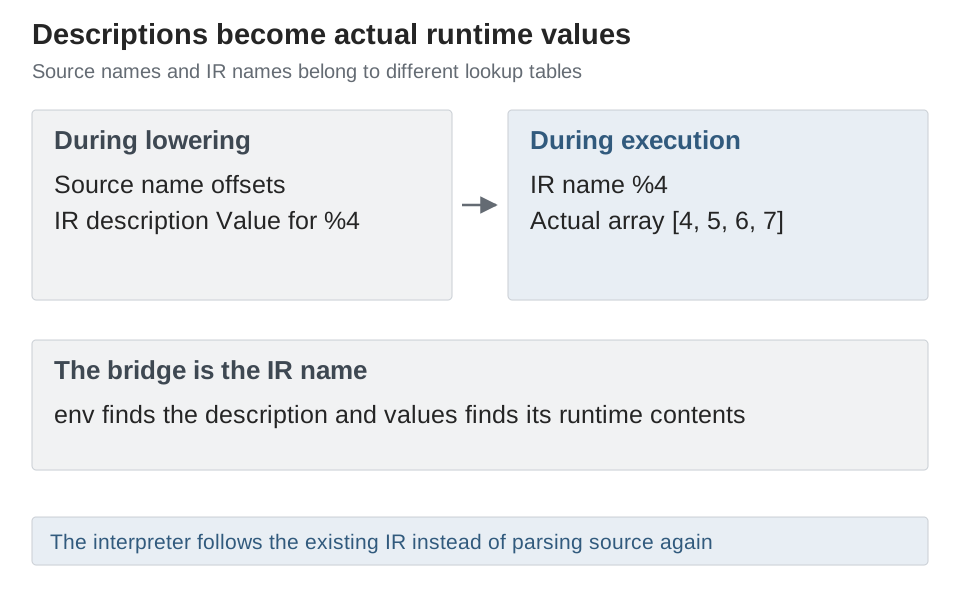
Consider the IR result that the first lesson called %4.
Value("%4", "int", (4,))
The record describes four integers but contains none of those integers. During
execution of program 1 with BLOCK=4, the corresponding contents will be a
NumPy array containing [4,5,6,7].
The interpreter therefore needs another dictionary. The first lesson's env
connects source names to IR descriptions. The new values dictionary connects
IR names to actual runtime contents.
| Table | Lookup | Meaning |
|---|---|---|
self.env |
env["offsets"] |
The Value describing %4 |
self.values |
values["%4"] |
The actual array of offsets |
self.arguments |
arguments["x"] |
The array supplied for this invocation |
The Value's name field connects the first two tables. Lowering uses source
names to construct instructions. Execution uses IR names to find the contents
that those instructions require.
2. Distinguish pointer arithmetic from array arithmetic
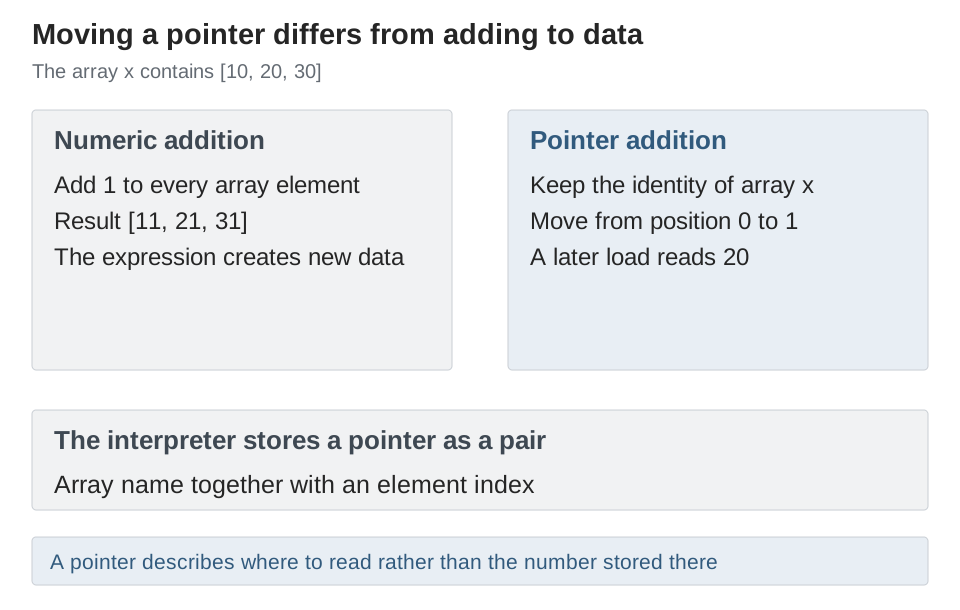
Suppose a NumPy array contains three numbers.
import numpy as np

x = np.array([10, 20, 30])
print(x + 1)
The result is [11,21,31]. NumPy performs numeric addition at each position and
produces a new array. It does not express moving from the first element to the
second element while leaving the stored numbers unchanged.
Pointer arithmetic describes that change of location. Our interpreter represents a pointer using a pair of an array name and an element index.
arguments = {"x": np.array([10, 20, 30])}
pointer = ("x", 0)

base, index = pointer
advanced = (base, index + 1)

base, index = advanced
print(arguments[base][index])  # 20
The pair ("x", 1) refers to the second element of the array stored under "x".
It does not contain the number 20. Reading the array at that location obtains 20.
An array is suitable for storing the data. The additional pointer representation lets the interpreter distinguish changing a location from changing a numeric value. This pair is a convention of the exercise rather than a universal requirement for interpreters.
For a tile, the index can itself be an array. The pointer
("x", np.array([4,5,6,7])) describes four candidate element locations.
The base remains "x" while address arithmetic changes the indices.
3. Bind inputs to one invocation
The interpreter receives the Program produced by lower, an argument
dictionary containing actual arrays and numbers, and an integer grid size.
The sample invocation uses six valid elements and eight output slots.
x = np.arange(6, dtype=np.float32)
y = np.full(6, 10, dtype=np.float32)
out = np.full(8, -99, dtype=np.float32)
arguments = {"x": x, "y": y, "out": out, "n": 6}
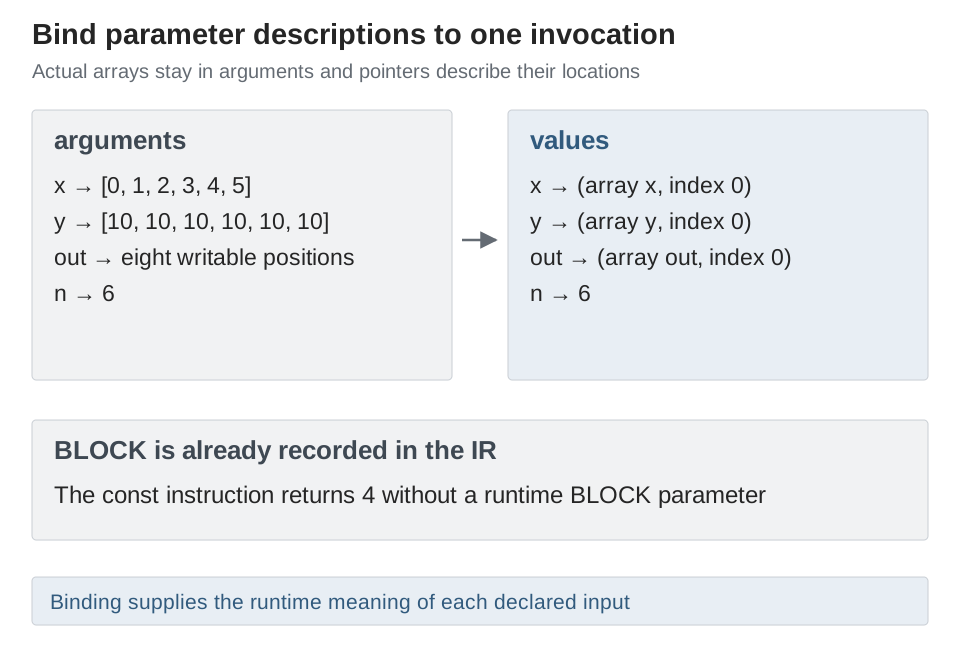
Step 1 describes x with Value("x", "ptr"). Step 2 binds that declaration to
its runtime representation by setting values["x"] to ("x", 0). The actual
array stays in arguments["x"].
Scalar parameters need no location representation. The input n is bound
directly to the supplied integer six.
| Parameter description | Entry in the runtime value table |
|---|---|
Value("x", "ptr") |
"x" maps to ("x", 0) |
Value("y", "ptr") |
"y" maps to ("y", 0) |
Value("out", "ptr") |
"out" maps to ("out", 0) |
Value("n", "int") |
"n" maps to 6 |
BLOCK is not another runtime parameter. The earlier call to
lower(function, block=4) already recorded the required constant in the IR.
The interpreter executes that constant instruction without consulting the
source annotation or resolving BLOCK again.
The compiler caller can know both the array length and the chosen width. The important distinction is which values are passed into lowering and which are passed into execution. Lowering received the width but did not receive these arrays or this invocation's length.
4. Run the same IR for each program instance
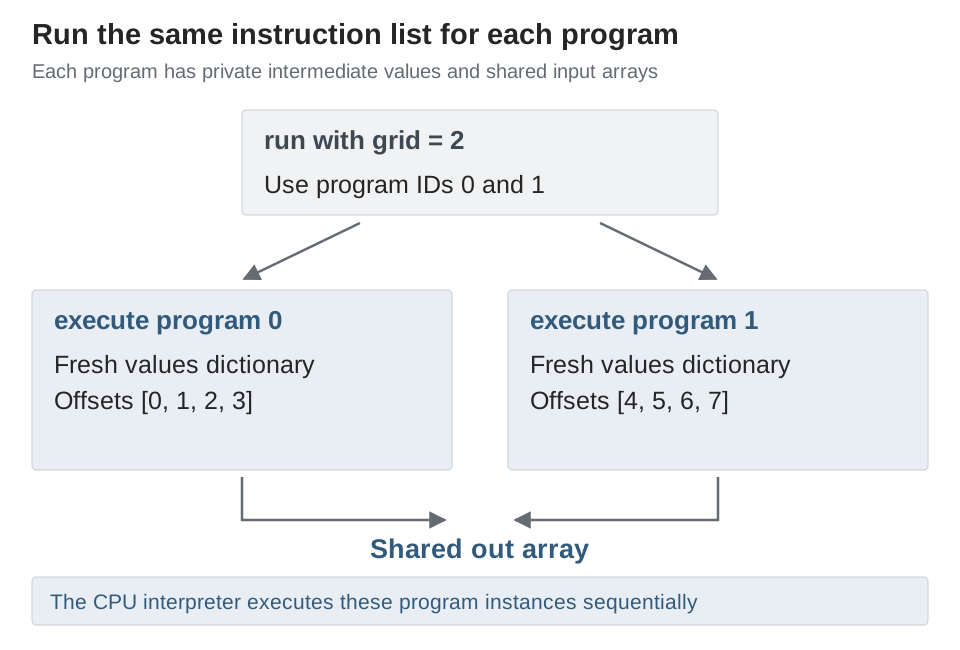
With n=6 and BLOCK=4, two program instances cover the input. Program 0 has
offsets [0,1,2,3]. Program 1 has offsets [4,5,6,7].
The supplied run method loops over integer program IDs and executes the same
IR for each one.
    def run(self, program, arguments, grid):
        for program_id in range(grid):
            self.execute(program, arguments, program_id)
Each call to execute creates a fresh runtime value table. The arrays in
arguments remain shared, so the two programs can write different positions
of the same output array. This CPU execution is sequential. It does not model
GPU scheduling or introduce threads.
run returns no output array. The invocation's result is the change made to the
supplied out array. After both programs execute, its first six entries should
contain [10,11,12,13,14,15]. The remaining two entries should still contain -99.
5. Execute instructions through name lookup
The exercise is in
problems/step02.py.
Its compiler inherits the first lesson's compiler. The run method is supplied.
The implementations of execute and evaluate are left as TODOs, including
their loops and conditions.
| Method | Responsibility |
|---|---|
run |
Execute all program instances |
execute |
Bind inputs and traverse one instance's instructions |
evaluate |
Perform one operation on actual runtime operands |
At the start of execute, initialize three fields.
| Field | Contents |
|---|---|
self.arguments |
The invocation's actual arrays and numbers |
self.program_id |
The current instance's integer ID |
self.values |
A fresh mapping from IR names to runtime contents |
After binding parameters, traverse program.body. Each instruction's args
contain Value descriptions rather than the actual operands. Lookup converts
those descriptions to their runtime contents.
operands = [self.values[value.name] for value in instr.args]
result = self.evaluate(instr, operands)
For %2 = mul(%0, %1), the inputs are Values named %0 and %1. If the value
table associates them with 1 and 4, the operand list is [1,4]. Evaluation
returns 4, which is then stored under the result name %2.
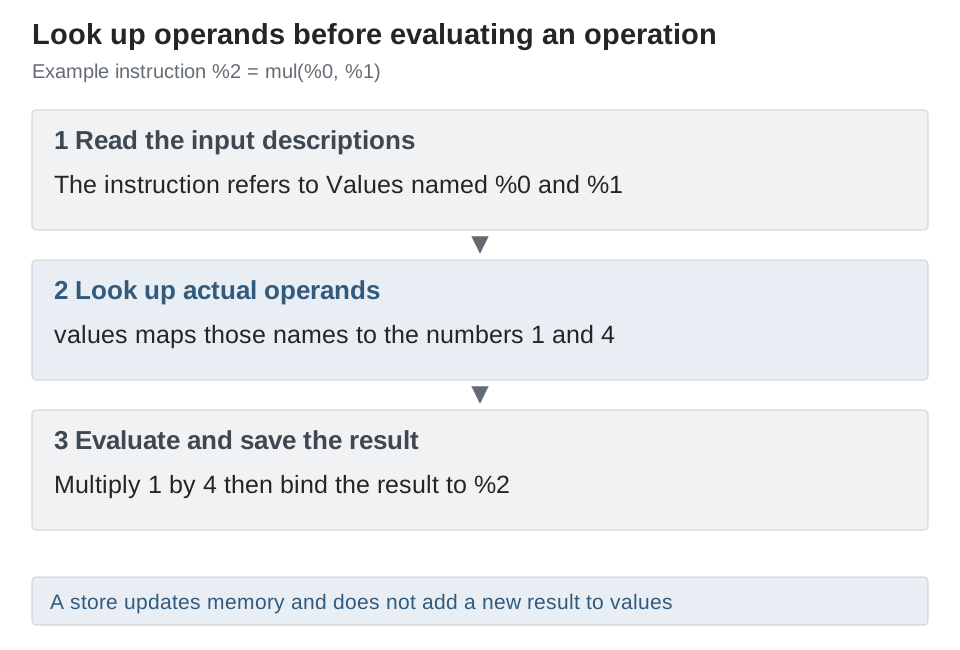
An instruction with result=None has no result name to bind. The store handler
has already modified memory, so traversal does not add an entry for it.
Keeping lookup in execute allows evaluate to work with actual operands and
lets later lessons add operations independently of traversal.
6. Give each operation an execution meaning
The evaluator receives an Instr and a list of runtime operands. The reference
implementation names that list a. This local parameter is unrelated to the
kernel's source variable named a.
| Operation | Runtime meaning |
|---|---|
const |
Return the value stored in the instruction's attributes |
program_id |
Return the current instance ID |
arange |
Create a NumPy array from the recorded start and end |
add |
Add the two actual operands |
mul |
Multiply the two actual operands |
lt |
Compare the two operands elementwise |
addptr |
Preserve the array name and advance its element index |
load |
Return data with the required mask and fallback behavior |
store |
Write only the selected positions |
NumPy supplies broadcasting for arithmetic. Adding the scalar four to
np.array([0,1,2,3]) produces [4,5,6,7]. Comparing that array with six produces
[True,True,False,False].
Pointer addition needs a separate case because its left operand is a pair.
(base, index), offset = a
return base, index + offset
For operands [("x", 0), np.array([4,5,6,7])], unpacking gives the base "x",
the index zero, and the tile offset array. The result is a pair containing
"x" and the indices [4,5,6,7]. No memory is read by this operation.
7. Apply the mask before reading memory
A six element array has no positions six or seven. A masked load must avoid reading those target addresses. Replacing results after a read is too late.
The following expression is therefore incorrect when the index array contains out of range positions.
np.where(mask, memory[index], other)
Python evaluates memory[index] before calling np.where. The array access
raises an IndexError before selection can occur. np.where is not a lazy
conditional that defers evaluating one of its inputs.
The reference implementation instead uses two selections.
safe_index = np.where(mask, index, 0)
loaded = memory[safe_index]
result = np.where(mask, loaded, other)
The first selection replaces inactive indices with zero. The second selection replaces their temporary read values with the fallback. For a nonzero fallback and an array whose first value is 100, these steps are visibly different.
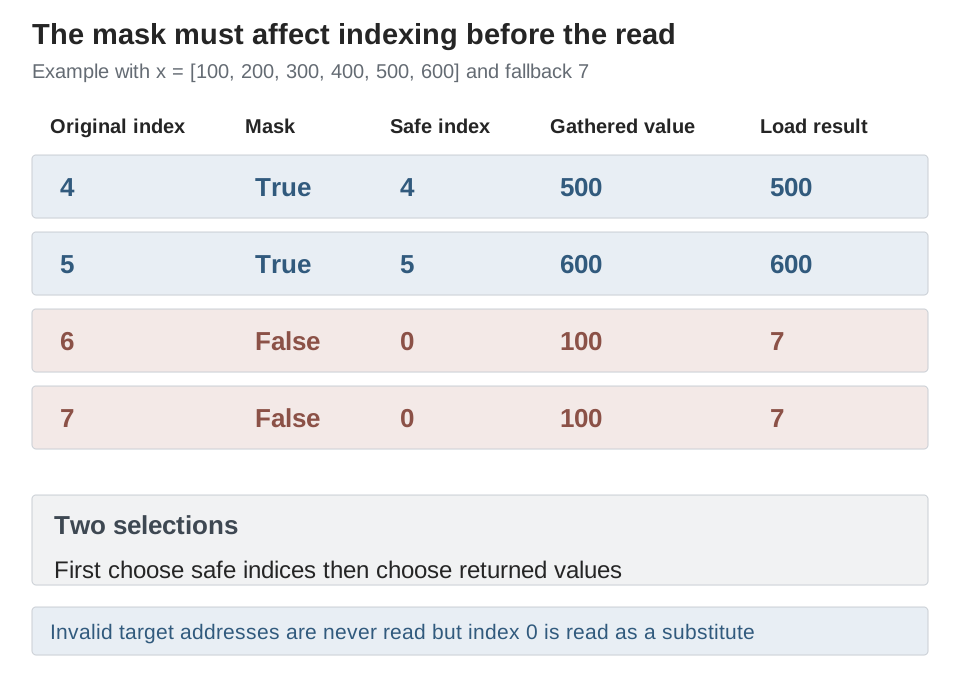
The example uses fallback seven to distinguish the returned fallback from the value at index zero. The vector addition kernel itself uses fallback zero.
This implementation avoids invalid target reads but performs a safe substitute read at index zero for inactive positions. It should not be described as performing no read of any kind for those positions. It also assumes that the backing array has an element at index zero whenever a load instruction executes. Launching a program that loads from an empty array is outside this reference implementation's supported cases.
memory = self.arguments[base].reshape(-1) provides a flat view of the sample
arrays. The lesson uses ordinary contiguous NumPy arrays. General handling of
arbitrary strided arrays would require additional care because reshaping can
produce a copy rather than a view.
8. Store only the selected positions
The store handler selects both the destination indices and the values before assigning them to memory.
self.arguments[base].reshape(-1)[index[mask]] = value[mask]
For program 1, index[mask] is [4,5] and value[mask] is [14,15]. The
assignment therefore writes only out[4] and out[5].
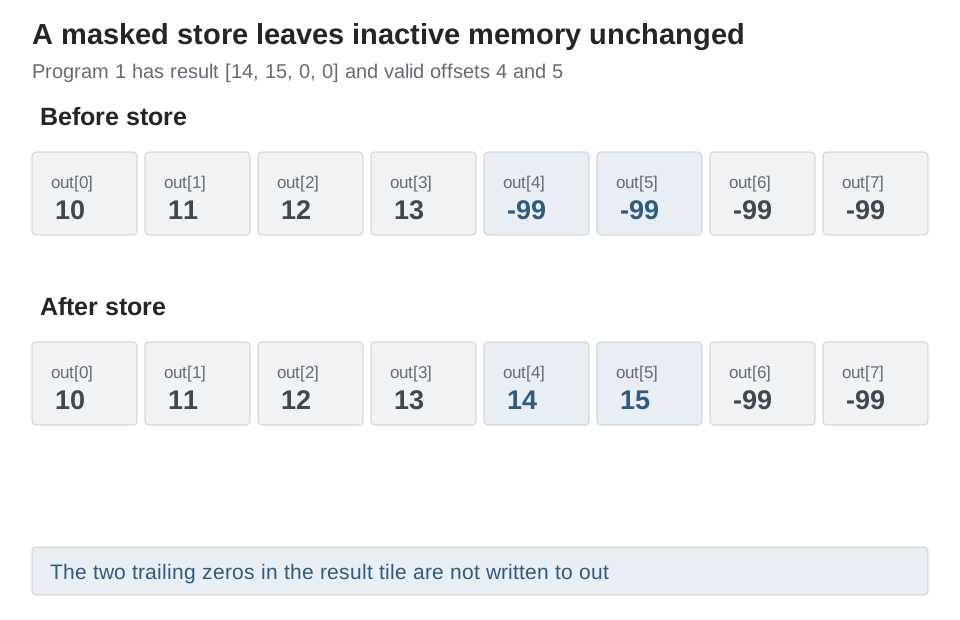
The fallback behavior of a load does not authorize a later store to write
inactive positions. Although the computed result tile ends with two zeros,
the output array's last two entries remain -99.
A store returns None because its effect is the memory update. The outer
instruction loop sees that there is no result Value and skips result binding.
9. The complete exercise implementation
Replace the two methods inside the existing Compiler class. Keep the supplied
run method and the first lesson's implementation. The following code matches
the companion repository's
reference implementation.
The indentation shown is the class indentation.
Bind inputs and execute one program
    def execute(self, program, arguments, program_id):
        # Runtime state is separate from the frontend's source-name table.
        self.arguments = arguments
        self.program_id = program_id
        self.values = {}
        for parameter in program.params:
            if parameter.kind == "ptr":
                # Keep the array name and element offset; addptr updates the
                # offset, and load/store find the array in self.arguments.
                value = (parameter.name, 0)
            else:
                value = arguments[parameter.name]
            self.values[parameter.name] = value

        for instr in program.body:
            operands = [self.values[value.name] for value in instr.args]
            result = self.evaluate(instr, operands)
            if instr.result is not None:  # stores change memory, with no result
                self.values[instr.result.name] = result
Evaluate one operation
    def evaluate(self, instr, a):
        """The value of one instruction, given the values of its arguments."""
        op = instr.op
        if op == "const":
            return instr.attrs["value"]
        if op == "program_id":
            return self.program_id
        if op == "arange":
            return np.arange(instr.attrs["start"], instr.attrs["end"])
        if op == "add":
            return a[0] + a[1]
        if op == "mul":
            return a[0] * a[1]
        if op == "lt":
            return a[0] < a[1]
        if op == "addptr":
            (base, index), offset = a
            return base, index + offset
        if op == "load":
            (base, index), mask, other = a
            memory = self.arguments[base].reshape(-1)
            # Inactive lanes read index 0 instead, then take `other`:
            # the mask must stop the read, not just replace the result.
            return np.where(mask, memory[np.where(mask, index, 0)], other)
        if op == "store":
            (base, index), value, mask = a
            self.arguments[base].reshape(-1)[index[mask]] = value[mask]
            return None
        raise NotImplementedError(op)
The final NotImplementedError preserves a useful failure for an unsupported
operation. Substituting a guessed value would hide the missing operation and
could silently corrupt later results.
10. Check the implementation
Install the published exercise dependencies from the companion repository root. If the repository is already cloned, pull the update before installing.
git pull
python -m pip install -e '.[dev]'
tinytriton check step02
The check includes the first lesson's contracts because the second lesson inherits its lowering implementation. An unfinished first lesson can therefore fail before execution reaches the second lesson's TODOs.
To check the supplied reference instead, use the explicit reference option.
tinytriton check step02 --solution
The cases cover full tiles, partial tiles, nonzero load fallbacks, reused IR with new invocation arguments, and an entirely inactive program. In each memory case, invalid target indices must not be read and inactive output positions must remain unchanged.
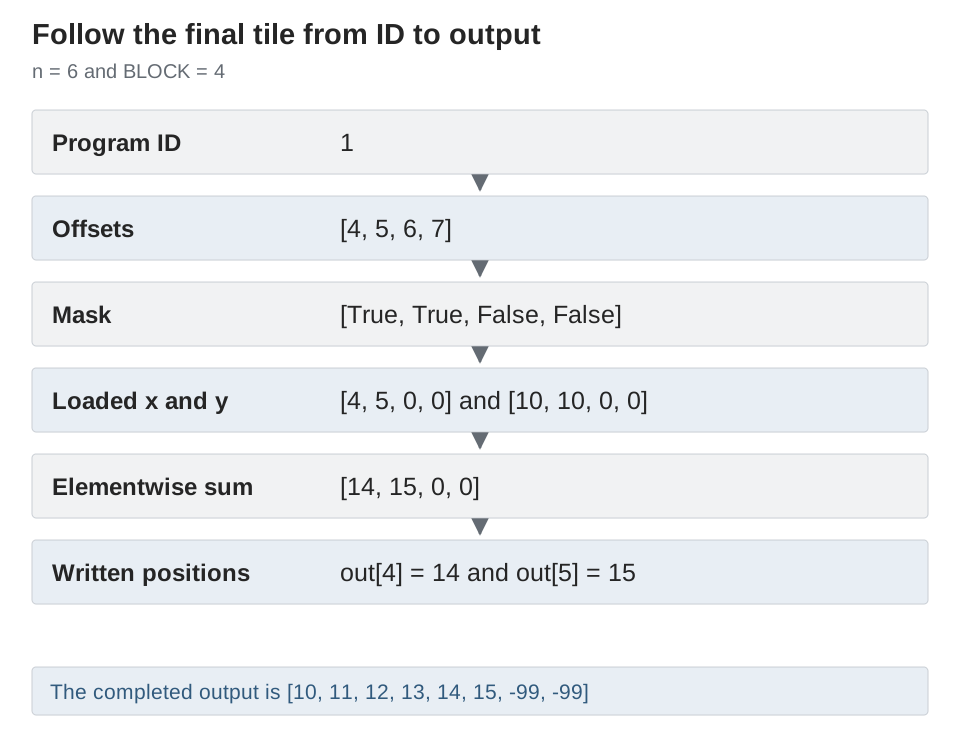
For the sample invocation, execution produces
[10,11,12,13,14,15,-99,-99]. That result follows from the IR's computation and
memory rules. The later GPU implementation must preserve the same result while
changing how the work is distributed and executed.